DA VID CLARKE, SANDRA FRID, & CARNE BARNETT
Download Proceedings

DA VID CLARKE, SANDRA FRID, & CARNE BARNETT
Download Proceedings
The following four documents are essential to read and complete when considering to submit a short communication to the MERGA conference.
Short communications are suitable for reports that do not fully meet the requirements for published papers. These might include works in preliminary stages, reports of pilot projects, initial reviews of literature, ideas or suggestions for future study, and briefer discussions of particular issues. Short communications allow new researchers to obtain feedback on projects in a constructive and supportive environment, and foster the building of links between researchers with similar interests.
Abstracts are required for short communications. They must be prepared using the conference template. The abstracts will be reviewed by the Editorial Team and, if accepted, will be published in the conference proceedings. Presenters are invited to prepare a paper for distribution at the conference, but these papers will not be included in the proceedings.
Short communications are presented by author(s) only. At least 5 minutes is to be allocated for audience questions and open discussion.
The Beth Southwell Practical Implications Award (BSPIA) recognises high-quality mathematics education that produces insights for the teaching profession and/or student learning.
The award consists of $500 and a plaque to be presented at the Conference.
The award recipient/s will be invited to present a plenary at the Conference and share a blog-style post about their work via the MERGA website and newsletter.
If you have any questions about the award, please contact Vice President (Development) Kristen Tripet: vp.development@merga.net.au
2023 Jill Fielding, Saidat Adeniji & Penelope Baker
2017 Margaret Thomas, Doug Clarke, Andrea McDonough & Philip Clarkson
2016 Bob Perry, Ann Gervasoni, Anne Hampshire & Will O’Neill
Please click here to view a complete list of BSPIA winners.
In 2022, a new nomination process is being trialled:
Nomination via peer-review: Anyone who submits a Conference paper for peer-review will be considered for nomination by the reviewers.
Self-nomination: When you submit your conference paper, check the box that asks if you would like to apply for the BSPIA.
Single and co-authored papers are eligible for consideration.
When you write your paper, please ensure that you observe all general paper submission requirements including the maximum page length. We are no longer requiring the submission of an additional two-pages.
Submissions must be deemed eligible for publication in the Conference proceedings by the initial reviewing panel. Submissions accepted for presentation only will be excluded from consideration.
The Conference Organisers and VP Development will shortlist up to five nominations for judging.
The judging panel will consist of two MERGA members and two AAMT nominees and will be chaired by the VP Development.
The judging criteria are:
Winners are notified four weeks prior to the Conference.
The Beth Southwell Practical Implications Award was initiated and sponsored by the National Key Centre for Teaching and Research in School Science and Mathematics, Curtin University, Perth, Western Australia. Curtin sponsored the “Practical Implications Award”, as it was known for the first ten years. The Award is now sponsored by the Australian Association of Mathematics Teachers (AAMT). In 2008, MERGA was honoured to be able to rename the PIA as the Beth Southwell Practical Implications Award, in honour of MERGA’s and AAMT’s esteemed late member, Beth Southwell.
The following four documents are essential to read and complete when considering to submit a research paper to the MERGA conference.
i. reports of empirical investigations; or
ii. reports that are not based on empirical research including:
– a theoretical discussion;
– a position paper;
– a report of scholarly enquiry in progress;
– a literature review, a meta-study;
– an account of a new initiative;
– a reflective critique of practice; or
– any mixture of these or other recognised scholarly forms.
All papers for publication in the conference proceedings should contain the following:
All papers must respect MERGA’s ethical guidelines relating to research work. Papers should be not more than the set length. (Formatting details and WORD template are available from the submissions). In addition, papers must be: readable; free of grammatical, spelling and typographical errors; and adhere strictly to style requirements advertised by the conference proceedings Editorial Team.
When empirical investigations are reported (such as in an experimental intervention, confirmatory study, or action research, etc.), the paper should also include
When the work is a theoretical discussion, a position paper, a report of scholarly inquiry in progress, a review of literature, a theoretical study, a meta-study, an account of a new initiative, a reflective critique of practice or any mixture of these or other recognised scholarly forms, the material presented must be discussed critically, and alternative points of view relating to themes presented should be appropriately argued.
It is expected that presenting authors will have 40 minutes to present their work at the conference. At least 10 minutes must be allowed to field questions and comments from the audience.
Only research papers that are substantially different from work that has been published previously will be considered for publication in the conference proceedings and/or presentation at the conference.
Research papers will be blind reviewed by a panel of peers approved by the conference committee. The main purpose of the refereeing process is to contribute to the growth and development of quality practice in mathematics education research. Thus reviewers are asked to assist authors by providing helpful feedback and to comment on the suitability of papers for presentation at the conference. Accordingly, it will not be assumed that published papers presented at the conference will be as polished as articles in scholarly journals. Referees will be asked to assess papers being reviewed against the accepted norms for scholarly works presented at MERGA conferences, as set out above.
Each conference proceedings’ Editorial Team will exercise discretion over the reviewing process.
Reviewers’ comments will be returned to the authors. Authors whose papers are not accepted for publication may be invited by the editorial panel to present their paper at the conference, with an abstract (only) being published in the proceedings. Papers may be rejected outright, with no opportunity for presentation at the conference in an alternative form.
The MERGA website has detailed advice about criteria for reviewing of MERGA papers, review forms, and examples of strong and poor reviews of different types.
Research papers are presented by author(s) only. A maximum of 30 minutes may be used for presenting the paper, and at least 10 minutes is then used for audience questions and open discussion.
There are four essential documents to read and complete when considering to submit a research paper to the MERGA conference.
Presentation of groups of published papers related by theme in the form a research symposium is encouraged. The symposium forum will be particularly suitable for presentations relating to a single large project or presentations that explore topical themes from different and/or related perspectives. Special Interest Groups [SIGs] are encouraged to consider the symposium option as a means for sharing and discussing current research.
A symposium should consist of no more than four presentations of about 15 minutes duration each. The written papers should be half the length of research papers as described for research papers. Both research report types – empirical or non-empirical – are acceptable as published symposium papers.
A brief overview of the symposium (limit one page), including a title, the names of presenters, an introduction to the theme/project, and a short introduction to each of the 3-4 contributions, must be submitted with the set of short papers.
The symposium proposer will also nominate a person to chair the symposium, and a discussant can also be named if desired. This information should accompany the collection of papers submitted for review.
The set of symposium papers (and the overview) will be blind reviewed by a review panel. The main purpose of the reviews is the same as for published papers, and the same criteria are used. The reviewers will be asked to consider the cohesiveness of the set of symposium papers. They will indicate whether the symposium as a whole, and each paper within it, should be “accepted”, “rejected” or if it “requires revision”. If it is deemed that one, some or all of the papers are in need of revision, the reviewers will outline which papers need to be revised and provide suggestions for the required changes. When the revisions are made, the symposium papers will be re-submitted and the set of papers will be sent to the same review panel for further consideration. As with research papers, the final decision about which symposium papers will be published is at the discretion of the Editorial Team.
The date for submission of the collection of symposium papers is the same as for Early Bird papers. This date has been set for the benefit of the group of authors of symposia papers. Should the symposium papers require revision, the authors will have the time to make the corrections and resubmit the set of symposium papers to be re-reviewed by the original reviewers.
Presentation of symposia
Symposia are presented by author(s) only. At least 10 minutes must be allocated for audience questions and open discussion.
In order to encourage new researchers in mathematics education, MERGA sponsors an award to an author in the early part of her/his career. The award, for excellence in writing and presenting a piece of mathematics education research, consists of a plaque and a prize of $500 and is presented at the annual conference. As part of winning the award, it is expected that the winning recipient will write a brief (one or two paragraphs) report for an upcoming MERGA newsletter.
2022 Lorraine Gaunt
|
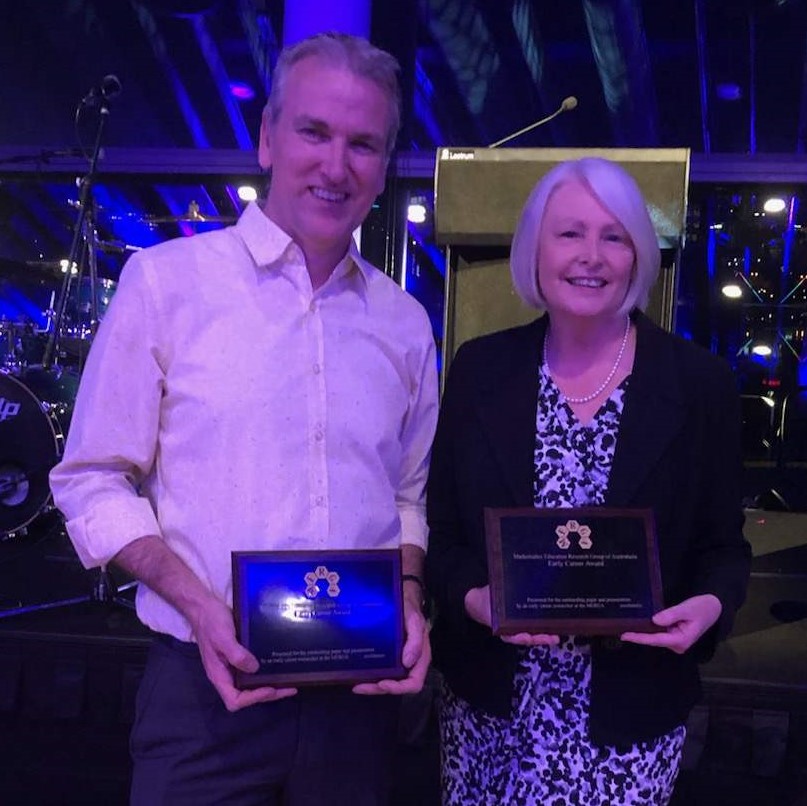
Entry for the Early Career Research Award is by submission of a written paper for presentation at the conference through the Early Bird process. Conditions of eligibility, information about the judging process, and the criteria judges will observe are indicated below. If you are applying for the Early Career Research Award, please ensure that when you upload your paper on the conference website, you also send an email to the Conference Secretariat indicating that you are an entrant for the Early Career Research Award. Note that at some MERGA conferences there is also a form to complete or a box to tick on the registration form, so check the conference website carefully. Please note that co-authored papers ARE NOT eligible for entry into the Early Career Research Award, nor are Round Table or Symposium papers.
Click here to check the rules and eligibility for the Early Career Award